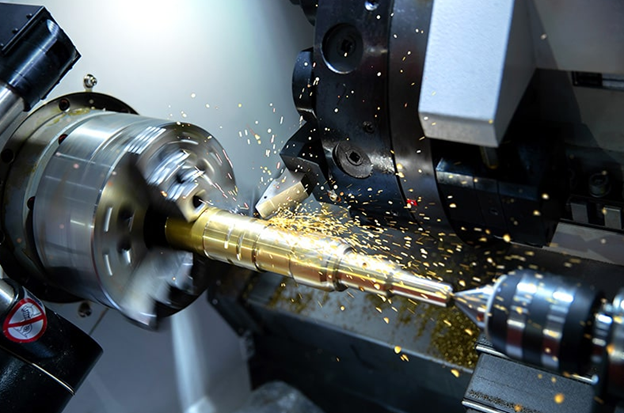
CNC turning service : There is a particular kind of manufacturing problem that only surfaces after a product has been in the field for months. Components that passed inspection, assembled without issue, and performed acceptably during testing begin failing under real operating conditions. Shafts wear unevenly. Seals leak. Threaded connections loosen under vibration. In a surprising number of these cases, the root cause traces back to turning decisions made during machining decisions that no inspection report captured because nobody thought to look. CNC turning services involve far more process complexity than most buyers ever consider.
Bar Stock Tells a Story
Sourcing bar stock is treated as a procurement task. It should be treated as an engineering one. The same alloy grade from different mills behaves differently under cutting loads not because the chemistry is wrong, but because grain orientation, residual drawing stress, and surface condition vary between suppliers. CNC turning service : A batch of shafts machined from a poorly drawn bar will show diameter variation that tightens and loosens unpredictably across a production run, even with identical machine settings. Machinists who request material certifications and track which stock batches produce which outcomes build a process knowledge base that directly improves batch-to-batch consistency. Most do not bother.
What Chuck Pressure Actually Does
The physics of clamping a thin-walled cylindrical component are counterintuitive until they have caused a problem. Standard three-jaw chucks concentrate clamping load at three contact points. CNC turning service : On a hollow part with limited wall thickness, this compresses the bore into a very slightly triangular form during machining. Everything measures correctly whilst the part is clamped. The moment it is released, the bore relaxes and the internal diameter is now out of round in a way that is nearly impossible to correct without remachining . CNC turning services handling precision hollow components use soft jaws machined to the exact external profile of the workpiece, spreading clamping force across the entire contact surface. It is not a complicated solution. It is simply one that requires the machinist to understand the problem in the first place.
Threading Failures Nobody Anticipates
A thread that passes a go/no-go gauge check is not necessarily a thread that will perform reliably in service. Worn insert tooling produces threads with slightly degraded flank geometry that gauges within limits but generates uneven load distribution across the engaged turns. Under vibration or thermal cycling, this manifests as loosening that cannot be explained by insufficient torque at assembly. Rolled threads formed by displacing material rather than cutting it produce a work-hardened surface layer with compressive residual stress at the root, which resists fatigue cracking considerably better than cut threads. CNC turning service : This distinction matters enormously in aerospace fasteners, hydraulic fittings, and any application where thread failure has serious consequences.
Single-Setup Discipline
CNC turning service : Concentricity between multiple diameters on a turned component is one of those specifications that looks straightforward on a drawing and becomes genuinely difficult in production. Every time a part is removed from the chuck and re-fixtured, a small repositioning error is introduced. Across several operations, these errors stack. CNC turning on a twin-spindle or sub-spindle lathe eliminates this by completing both ends of a component without breaking the original datum. The concentricity achieved this way is categorically better than anything produced by splitting operations across separate machines not marginally better, but reliably and measurably so across an entire production batch.
Surface Finish Is Functional
Specifying a surface finish on a bearing journal is not about appearance. Too rough, and the asperities on the shaft abrade the bearing race, generating heat and accelerating wear from the first hour of operation. Too smooth, and the surface cannot retain an adequate lubrication film, leading to metal-to-metal contact under load. CNC turning service : The correct finish sits in a specific range determined by the bearing type, lubrication method, and operating speed and achieving it requires a particular combination of insert radius, cutting speed, and feed rate that cannot be guessed at. Machinists who understand tribology make better decisions here than those who simply aim for a finish that looks clean.
Conclusion
CNC turning services determine far more about long-term component performance than a dimensional inspection report can reveal. CNC turning service : The decisions made around bar stock sourcing, clamping method, threading process, setup strategy, and surface finish specification collectively shape how a part behaves across thousands of operating hours. CNC turning service : Buyers who engage machining partners willing to discuss these specifics rather than simply confirming they can meet a tolerance consistently receive components that cause fewer field problems and require less warranty investigation.