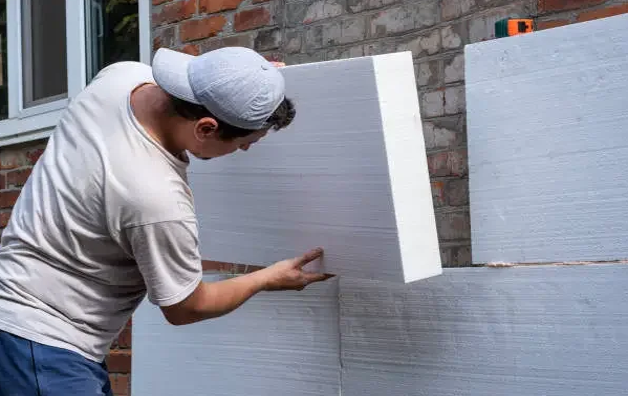
Stand near any building site long enough and you will spot it: pale white panels stacked against the scaffolding. Ask someone what they are for and you usually get one word back. Insulation. True enough, though it barely scratches the surface. An expanded polystyrene board is not just foam cut to size. It is the product of a manufacturing process most people never consider, one that explains how it behaves on site and in walls.
What’s Inside the Board
Initially, polystyrene is something completely different. Before anything happens to them, tiny plastic beads that are smaller than rice grains are placed in a hopper. The beads quickly and dramatically expand when steam strikes them. The inflated beads are packed into a mould by manufacturers, who then fuse them into a single block by applying pressure and heat. When a completed board is cut through, the bead outlines remain visible, like a cross-section of popcorn that has never completely melted. This is not ornamentation at all. How light the board feels, how it manages moisture, and how forgiving it is on the job site are all determined by the bead structure.
Air Insulates, Not Plastic
Here is something most people get backwards. Plastic alone is an average insulator, nothing special about it. The real work happens inside tiny cells trapped between fused beads, where still air sits doing very little, exactly the point. Air that cannot move cannot carry heat with it. Squash a board, even slightly, and that trapped air collapses; no clever chemistry rescues lost performance. This is why anyone storing foam boards stays fussy about stacking. Crushed corners are not just cosmetic damage.
What Colour Really Means
Not all boards are white. Spend time around a builders’ merchant and a darker, graphite-grey version turns up too, and the colour is not accidental. Grey boards carry a flame-retardant additive worked into the mix, slowing how readily the material catches and burns. White stays the standard, additive-free version, fine away from anything resembling a fire risk. Specify the wrong one for a project bound by stricter fire rules, and the mistake will not show up until it matters.
Grade Matters More Than Thickness
Thicker is sturdier, or so the logic goes. It is not quite that simple. Density grade has a bigger say in strength than thickness does, and a slim, dense expanded polystyrene board can outlast a thicker, looser one under load. Flooring and roofing work leans on this, calling for a particular grade rather than just thick enough. Swap grades without checking the specification, and the structure might sit fine for years, until quietly, it does not.
Where Most Installations Fail
Specification rarely causes real damage. Installation does. Leave gaps between panels, even hairline ones, and air finds a way through, undoing the insulating value the boards were meant to add. Installers who know their trade stagger the joints row by row, much like bricklayers, so no seam runs straight through a wall or roof. Tape gets pressed across every joint afterwards. Miss that step and an otherwise well-chosen expanded polystyrene board installation leaks warmth through gaps nobody notices, until the first cold snap arrives and draughts give it away.
The Material’s Real Weaknesses
Sunlight and soil undo this material faster than anything else. Left exposed without cladding or render, ultraviolet light turns crisp white panels yellow, then brittle, then crumbly. Below ground, damp soil works differently. Moisture wicks in slowly, and in some regions, insects burrow into the foam for shelter. None of this makes the material unreliable. It simply means covering it, pairing it with a vapour barrier, and keeping it away from direct sun and soil wherever possible.
Final Thoughts
All of this does not make specifying or installing an expanded polystyrene board difficult; in fact, if the fundamentals are understood, the reverse is true. When you comprehend the manufacturing process, fire ratings, density classes, and installation techniques that distinguish a neat job from a leaky one, the material ceases to seem mysterious. The majority of issues attributed to the product stem from seeing it as a single generic slab rather than a variety with genuine variance. When you make a decision with that in mind, it doesn’t merely borrow its reputation; it earns it.