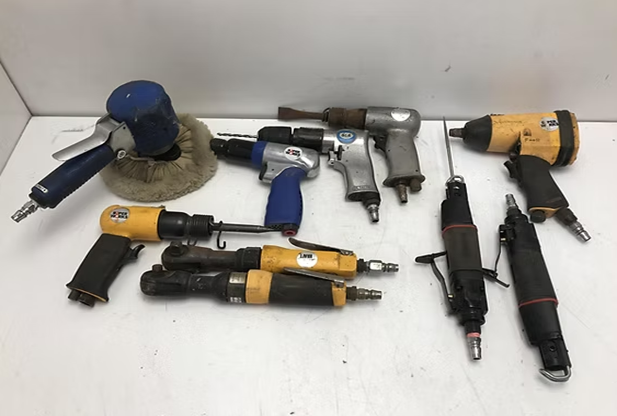
There is a telling moment that happens in almost every trade apprenticeship. The new starter arrives with a cordless kit, proud of the matching batteries and the clean carry case. Six months later, after enough repetitive work in enough demanding environments, they start quietly watching what the experienced hands are actually using. The shift happens without anyone pushing it. Pneumatic power tools do not need advocates the work makes the argument on their behalf, and it usually does not take long.
The Battery Lie Nobody Admits
Cordless tool manufacturers publish peak torque figures. What they do not publish is the torque figure at eighty percent battery depletion, or after the pack has been through a few hundred charge cycles and quietly lost capacity. Pneumatic tools do not have this problem because they do not have a battery. The output at the start of a shift and the output at the end are the same same pressure, same response, same result. For anyone running a production environment or working flat out on a vehicle repair job, that consistency is not a nice feature. It is the whole point.
What Fatigue Actually Costs
The weight conversation around pneumatic tools gets framed as a comfort issue, which undersells it completely. Fatigue in trade work is a quality problem, not just a physical one. Tired hands make sloppy cuts, over-drive fixings, and miss alignments that a fresh pair of hands would catch immediately. Pneumatic tools are lighter because they carry no battery mass, and that weight difference compounds across a full day of repetitive use in a way that is genuinely measurable in the quality of work produced in the final hours of a shift. The lightest cordless tool still weighs more than it needs to, and that excess is always paid for somehow.
Why Air Tools Last Longer
Pneumatic power tools run cool. That is not marketing language it is a mechanical consequence of how compressed air behaves as it expands through the tool during operation. Heat is the primary enemy of motor windings, electronic speed controllers, and battery cells in electric tools. Air tools sidestep that entire failure pathway. The mechanisms are simpler, the moving parts fewer, and the thermal load negligible by comparison. In a professional workshop where tools are in near-continuous use rather than occasional domestic service, that translates into service intervals measured in years rather than months and repair bills that are a fraction of what an equivalent electric tool demands.
The Compressor Economy
This is the part that does not get explained well to people setting up workshops for the first time. One compressor serving multiple tools simultaneously is a fundamentally different economic and operational model from maintaining individual battery ecosystems for every tool in the shop. Pneumatic power tools share a single energy source without any of the battery management overhead no tracking charge states, no rotating packs, no replacing cells that have degraded past usefulness. The compressor runs, the tools work, and the entire system scales simply by adding hose drops rather than buying into yet another battery platform.
Where Pneumatics Have No Equal
Spray finishing is the most obvious example, but it is worth being specific about why. The atomisation quality achievable through a pneumatic spray gun the ability to dial pressure, fluid flow, and fan pattern independently produces surface finishes that define professional standards in automotive refinishing, furniture lacquering, and industrial coating. No electric alternative replicates that level of adjustment or that quality of result at production volume. The same principle applies to pneumatic sanders in coachbuilding and pneumatic nailers in flooring installation, where drive consistency across hundreds of fixings is what separates professional work from amateur results.
Conclusion
Pneumatic power tools persist in professional environments not because tradespeople are resistant to change but because the alternatives have not yet matched what air tools actually deliver under sustained working conditions. Consistent output, lower weight, simpler mechanics, and shared infrastructure are not marginal gains they are the foundations of productive, high-quality trade work. The cordless revolution changed weekend DIY significantly. On a serious workshop floor, the compressor still runs all day, and the experienced hands are still reaching for air tools first.