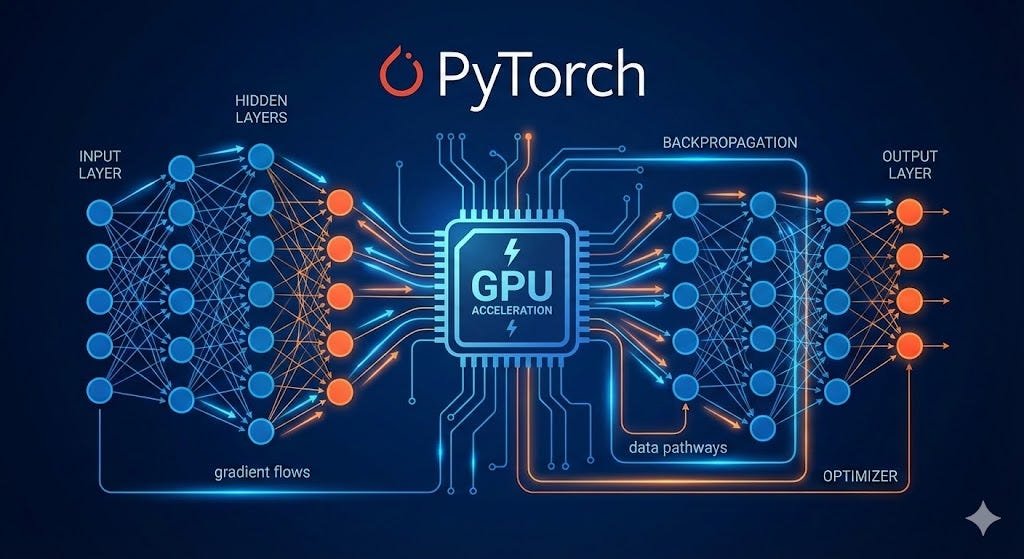
PyTorch: Machine learning rarely lives in isolation anymore. In real companies, models are part of larger products that include backend services, user interfaces, data pipelines, and business logic. PyTorch works well in these environments because it integrates smoothly with how engineering teams already build and maintain products.
Rather than being a research-only tool, PyTorch has matured into something that fits naturally into product engineering workflows. Teams can experiment, deploy, monitor, and iterate without constantly switching technologies or rewriting codebases.
Where PyTorch Sits in a Typical Product Stack
In most real-world products, PyTorch does not operate alone. It usually connects to data storage systems, APIs, cloud infrastructure, and frontend applications. PyTorch models are often one component in a larger system that delivers predictions or insights to users.
Because PyTorch is Python-based, it integrates easily with backend frameworks, data processing tools, and automation pipelines. Engineers can treat models as services rather than isolated scripts, making them easier to maintain and scale.
This ability to blend into existing stacks is a major reason PyTorch is widely adopted in production environments.
Collaboration Between Data Scientists and Engineers
One common challenge in product teams is the gap between data scientists and software engineers. Data scientists focus on experimentation and accuracy, while engineers prioritize reliability and scalability.
PyTorch helps bridge this gap. Its readable, imperative coding style makes models easier to understand for engineers who may not specialize in machine learning. At the same time, it gives data scientists the flexibility they need to test ideas quickly.
This shared understanding reduces friction and speeds up development cycles.
From Notebook to Product Feature
Many PyTorch projects start in notebooks. This is useful for exploration but becomes problematic if notebooks are treated as production systems. Successful teams treat notebooks as temporary tools and move core logic into structured codebases.
PyTorch makes this transition easier because code written for experimentation can be refactored into modules without major changes. Training loops, model definitions, and evaluation logic can all be reused in production environments.
This continuity saves time and reduces errors when moving from research to product features.
Handling Data in Live Systems
Products that rely on machine learning must handle live data streams, batch updates, or user-generated inputs. supports flexible data loading mechanisms that can be adapted to these scenarios.
Custom datasets and loaders allow teams to control how data is processed in real time. This is important when data quality varies or when preprocessing steps must evolve over time.
Efficient data handling ensures models remain responsive even as usage grows.
Deployment as Part of Engineering Pipelines
In engineering teams, deployment is automated. models fit well into continuous integration and deployment pipelines. Models can be versioned, tested, and deployed alongside other services.
Tools like TorchScript allow models to run in environments where Python is not ideal, improving performance and reliability. This makes it easier to embed models into APIs, microservices, or edge devices.
Automation reduces manual errors and allows teams to update models confidently.
Maintaining Models Over Time
Once a model is part of a product, it requires ongoing maintenance. Data changes, user behavior shifts, and performance can degrade. PyTorch supports retraining and fine-tuning workflows that help teams keep models up to date.
Monitoring systems track accuracy, latency, and resource usage. When issues arise, teams can retrain models with new data and deploy updates without major downtime.
This lifecycle management is critical for products that depend on consistent predictions.
When Teams Need External Expertise
As products grow, complexity increases. Teams may struggle with optimization, scaling, or long-term maintenance. At this stage, many organizations decide to hire pytorch developers who have experience working within product engineering environments.
These specialists understand not just model training, but also integration, deployment, and collaboration with engineering teams. Their experience helps avoid costly mistakes and ensures systems remain reliable as products scale.
Balancing Speed and Quality
Product teams often face pressure to deliver features quickly. PyTorch supports fast iteration, but quality cannot be sacrificed. Testing, validation, and code reviews remain essential.
Well-structured PyTorch projects include automated tests for data pipelines and model behavior. This reduces the risk of unexpected failures when new features are released.
Balancing speed and quality ensures products evolve without breaking user trust.
Scaling With User Growth
As user bases grow, systems must handle increased traffic. supports scalable inference through batching, hardware acceleration, and distributed systems.
Engineering teams can scale services horizontally or vertically depending on demand. PyTorch’s performance optimizations ensure models remain responsive even under heavy load.
This scalability makes PyTorch suitable for both early-stage products and mature platforms.
Long-Term Fit for Product Teams
Product teams need tools that evolve with them. PyTorch’s strong community and ongoing development ensure it remains relevant as techniques and requirements change.
New architectures, optimization methods, and deployment tools are regularly introduced. Teams can adopt these improvements incrementally without abandoning existing systems.
This adaptability makes PyTorch a long-term fit rather than a temporary solution.
Final Thoughts
PyTorch fits naturally into real product engineering teams because it balances flexibility with structure. From experimentation to deployment and long-term maintenance, it supports the full lifecycle of machine learning features.
For teams building products that rely on intelligent behavior, PyTorch offers a practical, scalable foundation that grows alongside both technology and business needs.